
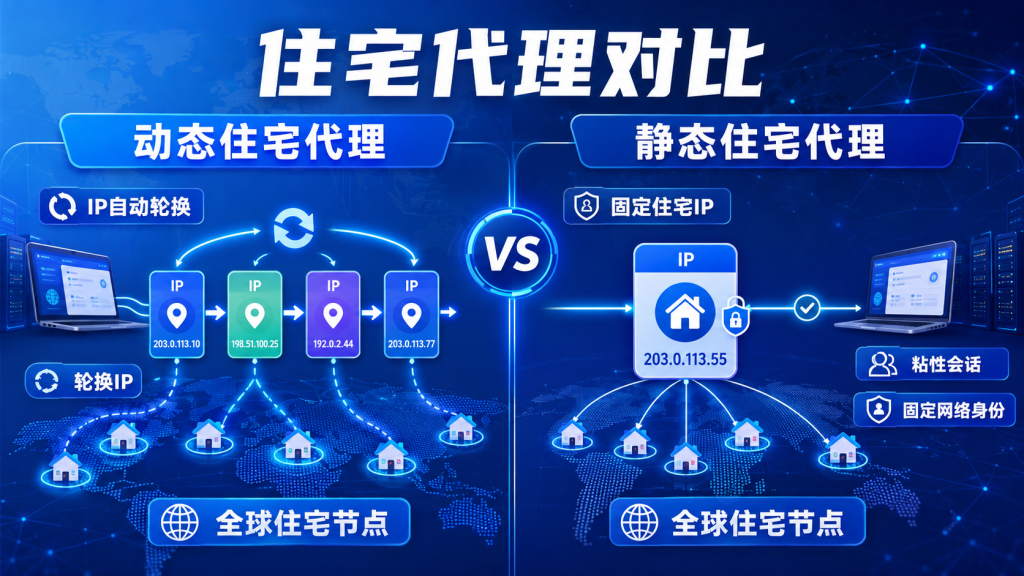
When choosing residential proxies, most people start by asking:
“How much does one IP cost?”
“How is traffic billed?”
“Is there a cheaper plan?”
But in 2026, price is no longer the main factor that decides whether a project succeeds or fails. The real question is: what kind of IP environment does your business actually need?
Even within residential proxies, price monitoring, account management, ad verification, and mobile testing require completely different proxy types. If you choose only by price, the common result is predictable: you buy a batch of dynamic IPs, then realize your login sessions keep dropping. Or you try to save money by sharing one static ISP IP across multiple accounts, only to have those accounts linked by the platform.
This article helps you identify your use case first, then decide whether dynamic residential proxies, static ISP proxies, or mobile 4G proxies are the right choice.
1. Answer These Four Business Questions First
Before comparing prices, use these four questions to define your requirements.
| Question | Possible Answer | Impact on Proxy Choice |
|---|---|---|
| Is my task short-request scraping or long-term account management? | Short requests / Long sessions | Short requests suit dynamic residential proxies; long sessions usually need static ISP proxies |
| How long do I need to keep the same IP? | A few seconds / Tens of minutes / Long term | The longer the duration, the more you depend on a stable exit and session capability |
| What type of platform am I accessing? | E-commerce / Search / Social / Ads / App | Different platforms use different risk controls and have different IP trust requirements |
| Am I more worried about failed requests or account linking? | Failure rate / Linking risk | If failures matter most, look at concurrency and success rate; if linking matters most, focus on isolation and environment consistency |
If you can clearly answer these four questions, you have already completed half of the proxy selection process.
2. Use Case 1: Large-Scale Scraping — Choose Dynamic Residential Proxies
Typical tasks include:
- E-commerce price monitoring
- Product stock checking
- Search result scraping
- Public web data collection
- Ad creative monitoring
These tasks share common characteristics: high request volume, distributed target pages, and no need to stay logged in for a long time during each session.
Why dynamic residential proxies are suitable
Dynamic residential proxies distribute requests across a large number of real home-network IPs, reducing the access frequency on any single exit. For large-scale scraping, their value is not simply “cheaper IPs,” but the ability to spread load more effectively.
What should you evaluate?
Country, state, and city targeting
If your data varies by region—for example local prices, stock levels, or ad displays—confirm the location targeting granularity first.
Session persistence
Some tasks need to keep the same exit for several minutes, such as paginated scraping or continuous search-result browsing.
In these cases, rotating the IP on every request may not be ideal. A short sticky session is often more useful.
Concurrency
For scraping tasks, confirm how many concurrent requests the provider can support. Total traffic volume alone is not enough.
Failure retry strategy
When you encounter 429, 403, or timeout errors, do not blindly retry without limits. Adjust your strategy based on status codes, page content, and request intervals.
When dynamic residential proxies are not suitable
If your task requires long-term login, persistent cookies, or a stable account environment, dynamic residential proxies may not be the best choice. Frequently changing IPs can interrupt sessions and trigger platform risk controls.
Related product: Dynamic Residential Proxies
3. Use Case 2: Account Management — Choose Static ISP Proxies
Typical tasks include:
- E-commerce store management
- Long-term social media account maintenance
- Cross-region account login
- Fixed-region identity simulation
- Automation tasks that require a stable exit
For these tasks, the key is not the number of IPs, but identity stability.
Why static ISP proxies are suitable
Static ISP proxies provide a relatively fixed residential-style IP exit, which makes them suitable for maintaining the same business identity over time. For account management, a trusted account environment is built from a stable IP, cookies, device settings, and consistent login behavior.
What should you evaluate?
IP usage period
Confirm how long an IP can be retained and whether it stays the same after renewal.
Region matching
The account registration region and the common login region should be as consistent as possible.
Exclusive or isolated usage
Multiple important accounts should not share the same exit IP for a long time. If one account has a problem, it may affect the others.
Stability
Focus on availability, latency, and disconnection frequency instead of only looking at unit price.
When static ISP proxies are not suitable
Static ISP proxies are not meant to serve as a high-frequency scraping pool. Sending a large number of scraping requests through a small group of fixed IPs wastes the value of a static IP and can easily cause the exit to be restricted.
Related product: Static ISP Proxies
4. Use Case 3: High-Trust Mobile Environments — Choose Mobile 4G Proxies
Typical tasks include:
- Mobile app testing
- Mobile ad verification
- Social media account management
- Mobile page display checking
- Businesses that require strong consistency between device and network environment
Why mobile 4G proxies are suitable
Mobile 4G proxy exits come from real mobile networks. Since many real users share similar IP ranges, platforms often give these IPs higher trust.
That said, mobile 4G proxies are not a universal replacement. They usually require more attention to availability, carrier coverage, and latency, and they are not always the cheapest option.
What should you evaluate?
Carrier coverage
Confirm whether the provider supports the carriers and regions you need.
IP switching mechanism
Understand whether IPs rotate automatically, change by time, or can be maintained by session.
Mobile authenticity
For app testing and ad verification, the IP, device, language, time zone, and User-Agent should remain consistent.
Latency and success rate
Mobile networks fluctuate more than fixed broadband, so real testing on your target business is essential.
Related product: Mobile 4G Proxies
5. A Quick Comparison of Use Cases and Proxy Types
| Business Scenario | Recommended Type | Core Reason | Main Risk |
| Large-scale price scraping | Dynamic residential proxies | Distributes requests and reduces pressure on single IPs | Excessive concurrency increases failure rates |
| Search result scraping | Dynamic residential proxies | Supports regional variety and many short requests | Requests that are too frequent trigger 429 errors |
| E-commerce store management | Static ISP proxies | Long-term fixed identity and stable sessions | Multiple accounts sharing one IP causes linking |
| Social media account maintenance | Static ISP or mobile 4G | Requires a stable and trusted environment | Inconsistent environments trigger risk controls |
| Ad verification | Mobile 4G or dynamic residential | Depends on ad channel and region | Mismatched region or device parameters |
| Mobile app testing | Mobile 4G proxies | Closer to real mobile networks | Unstable latency and coverage |
| Account registration | Mobile 4G or static ISP | Requires a high-trust exit | Frequent environment changes affect account quality |
6. How Should You Compare Prices?
Price matters, but unit price alone is not enough. When evaluating residential proxy costs, use this formula:
Real cost = Listed price ÷ Effective request rate
For example:
- Provider A is cheap, but many requests fail or time out.
- Provider B costs more, but has a higher success rate, fewer retries, and shorter task completion time.
From a total project-cost perspective, Provider B may actually be cheaper.
Six metrics worth comparing
| Metric | Why It Matters |
| Effective request success rate | Directly affects whether tasks can be completed |
| Average response time | Affects scraping cycles and automation efficiency |
| Concurrency capability | Determines whether the service can support your scale |
| Geographic coverage | Affects the accuracy of localized data |
| Session capability | Determines whether login and continuous access can be maintained |
| Technical support response | Determines whether problems can be diagnosed quickly |
7. Common Proxy Selection Mistakes
1. Focusing only on IP quantity
A large number of IPs does not guarantee a high success rate. If your requests are concentrated on a small number of exits, a large IP pool will not help.
2. Using static ISP proxies as a scraping pool
The value of static ISP proxies is stable identity, not high-frequency rotation. Pushing large volumes of scraping traffic through a few fixed IPs can easily lead to restrictions.
3. Changing IPs too frequently for account management
Accounts need a stable login environment. Frequently switching countries, devices, time zones, and languages can trigger risk controls more easily than the IP itself.
4. Ignoring status code meanings
When you see 403, 429, or timeout errors, immediately switching IPs may hide the real problem. First determine whether the issue is authentication, rate limiting, target-site failure, or a proxy network problem.
For more details, see: Don’t Rush to Change IPs: A Diagnostic Guide to 429, 403, Timeout, and 5xx Proxy Errors
8. Recommended Combined Strategy
In real business operations, many teams do not rely on only one proxy type. A better approach is to separate environments by task:
| Task | Recommended Type |
| Public data scraping | Dynamic residential proxies |
| Price and stock monitoring | Dynamic residential proxies |
| Store backend management | Static ISP proxies |
| Important account login | Static ISP or mobile 4G |
| Mobile ad verification | Mobile 4G proxies |
| App automation testing | Mobile 4G proxies |
The advantage of this combination is that scraping environments focus on distribution, while operational environments focus on stability. The two goals do not interfere with each other.
9. Conclusion: Define the Use Case Before Setting the Budget
When choosing residential proxies in 2026, follow this decision order:
- Determine whether your business is scraping or account management.
- Decide whether you need short sessions or long-term identity stability.
- Confirm target platforms and regional requirements.
- Evaluate success rate, concurrency, and latency.
- Compare prices last.
If your budget is limited, protecting the stability and success rate of core business tasks is even more important. A cheap proxy that causes failed tasks, abnormal accounts, or repeated development work may ultimately cost more.
If you want to learn more about the differences between these three proxy types, read: How to Choose Residential Proxies in 2026: Dynamic Residential vs Static ISP vs Mobile 4G