
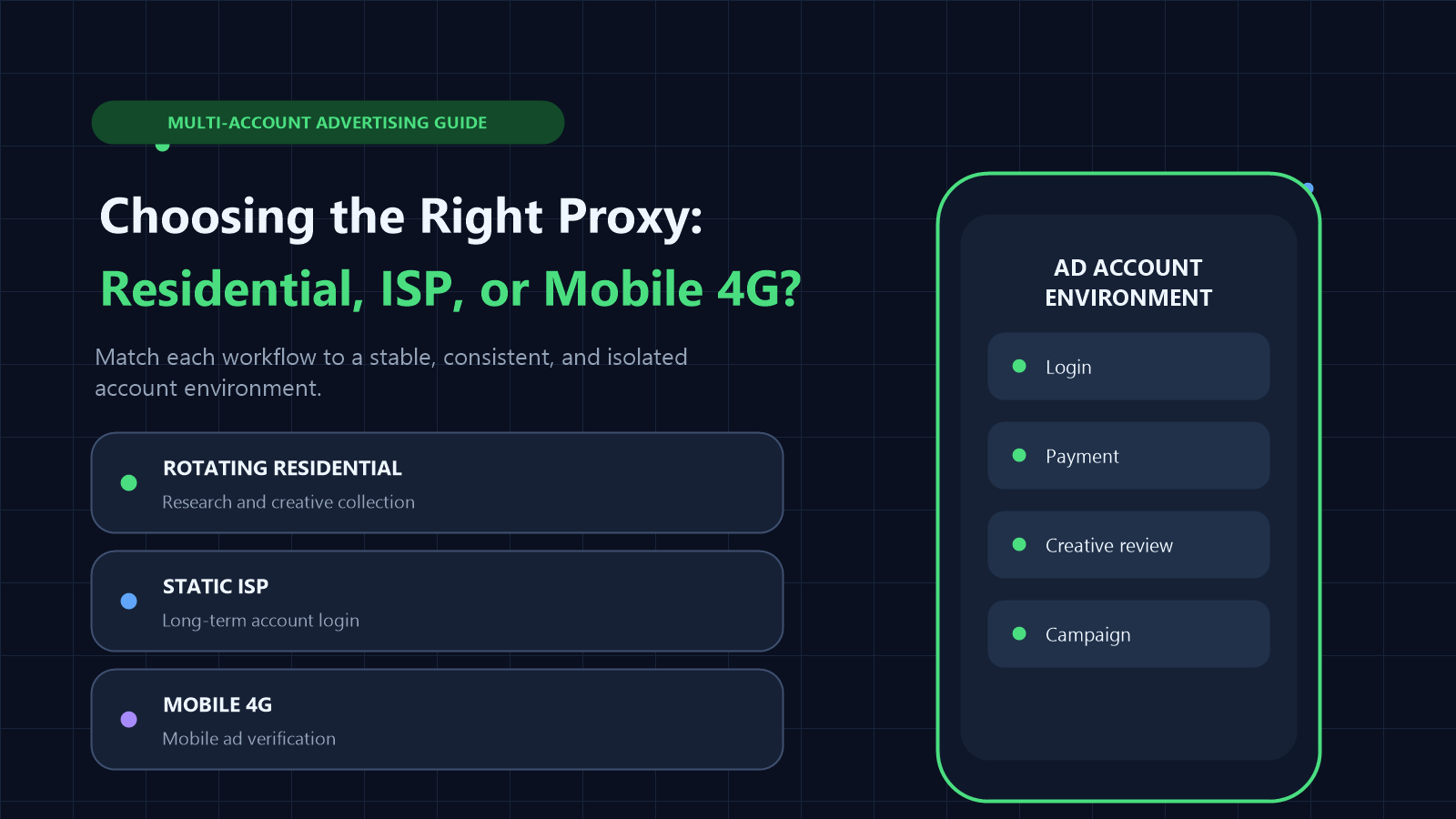
# How to Choose Proxies for Multi-Account Advertising: Residential, ISP, and Mobile 4G Compared
For multi-account advertising, the biggest risk is usually not “not enough IPs.” It is an unstable account environment.
The same ad account may log in from the United States today and from another country tomorrow. It may use a fixed broadband connection one day and a datacenter IP the next. Logins, payments, ad reviews, and daily campaign activity may come from different exits. Even when the proxy connection works, the ad platform may still interpret these changes as abnormal.
This guide explains how rotating residential proxies, static ISP proxies, and mobile 4G proxies differ, and how to choose the right option for each part of your advertising workflow.
1. Start With What Ad Accounts Fear Most
Multi-account advertising is not about “hiding.” The goal is to keep every account stable, credible, and consistent.
| Factor | Why it matters |
|---|---|
| IP stability | A recurring login environment should not change constantly |
| Location consistency | Account details, payment methods, target markets, and login regions should match |
| Session persistence | Logins, reviews, payments, and daily operations should come from a stable environment |
| Account isolation | Multiple accounts should not share the same exit IP for long periods |
| Operating behavior | Device, browser fingerprint, activity time, and workflow should remain predictable |
2. Rotating Residential Proxies: Research and Collection
Rotating residential proxies use changing exits and distribute requests across a large pool of residential IPs.
Best for:
- Ad creative monitoring
- Competitor landing page research
- Search result checks
- Regional pricing and promotion monitoring
- Public content collection
Strengths:
- Broad IP coverage
- Effective request distribution
- Suitable for short-session tasks
- Lower pressure on any single exit
Not ideal for:
- Long-term maintenance of an advertising account
- Strong-session operations such as logins, payments, and reviews
- Business identities that must remain fixed
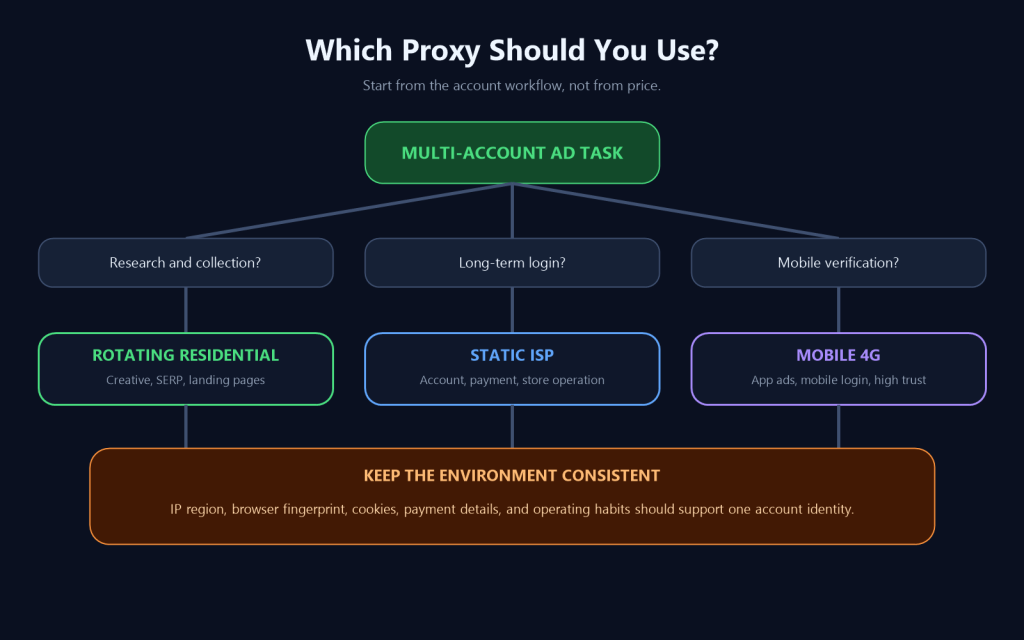
In multi-account advertising, rotating residential proxies work better as an external research tool than as the primary environment for account logins.
Explore: Rotating Residential Proxies
3. Static ISP Proxies: Long-Term Account Operations
Static ISP proxies provide a relatively fixed exit IP, making them suitable for accounts that need a stable long-term identity.
Best for:
- Daily advertising account logins
- E-commerce store operations
- Customer service platform access
- Payment and payout environments
- Fixed-region business identities
What to evaluate:
- IP retention period
Check how long the IP can be used and whether it remains the same after renewal.
- Location targeting
Account information, payment region, and login region should match whenever possible.
- Account isolation
High-value accounts should not share one static IP indefinitely.
- Availability
Advertising accounts are especially sensitive to disconnections and frequent exit changes.
When an account must be used for a long time, stability is usually more valuable than the lowest price.
Explore: Static ISP Proxies
4. Mobile 4G Proxies: Mobile and High-Trust Use Cases
Mobile 4G proxies use real carrier networks. Because many genuine users share similar network ranges, platforms often give these connections higher trust.
Best for:
- Mobile ad verification
- In-app advertising tests
- Social media account operations
- Mobile login environments
- Accounts that require a higher-trust network environment
What to evaluate:
- Carrier and country targeting
- Long-session capability
- Connection stability
- Suitability for the target ad platform
- Whether the account also needs a matching mobile device environment
Mobile 4G proxies are not a universal solution. If browser fingerprints, cookies, payment details, and operating habits are inconsistent, a mobile IP alone will not remove the risk.
Explore: Mobile 4G Proxies
5. A Quick Comparison Table
| Task | Recommended proxy | Reason |
|---|---|---|
| Competitor ad creative collection | Rotating residential | Distributes requests and suits large-scale short sessions |
| Regional landing page checks | Rotating residential / Mobile 4G | Requires multiple regions and network types |
| Daily ad account logins | Static ISP | Requires a stable identity and long-term consistency |
| Payment and payout environment | Static ISP | Environment stability is more important than low price |
| Mobile app ad verification | Mobile 4G | Closer to a real mobile user network |
| High-trust social accounts | Mobile 4G / Static ISP | Depends on the platform and account habits |
| Large-scale keyword checks | Rotating residential | Supports concurrency and request distribution |
6. Accounts, IPs, and Browsers: The Right Relationship
A common question is: “Does every account need its own IP?”
A better principle is: one stable account environment should correspond to one stable exit.
At minimum:
- Do not frequently change the country used by the same account.
- Do not perform logins, payments, and reviews from completely unrelated networks.
- Do not let multiple high-value accounts share the same IP indefinitely.
- Keep browser cookies, language, time zone, and user agent consistent with the IP region.
- Do not mix high-volume data collection traffic with account login traffic.
If you only manage a few accounts, one account can correspond to one static ISP or mobile exit. If you manage many accounts, avoid assigning dozens of accounts to one fixed IP.
7. Do Not Rely Only on IP Scores
IP-checking tools can be useful references, but they cannot determine whether an advertising account is safe.
Why:
- IP scores reflect only certain databases and historical records.
- Different ad platforms use different risk models.
- Account risk comes from a combination of IP, device, cookies, payment details, and behavior.
- A “clean” IP can still become unreliable if many accounts abuse it.
- An average-score IP may work well when the overall environment is stable.
A more reliable test:
- Select 3–5 real accounts.
- Keep the same device and browser configuration.
- Assign different proxy types to each group.
- Observe them continuously for 1–2 weeks.
- Record login success, verification frequency, payment issues, and account status.
| Metric | What to watch |
|---|---|
| Login success rate | Frequent secondary verification or security checks |
| Session stability | Unexpected logouts |
| Payment verification | Abnormal blocks or review delays |
| Ad review | Unexplained delays |
| Account status | Restrictions, suspensions, or re-verification requests |
8. Recommended Selection Workflow
Step 1: Separate business tasks
Divide the work into:
- Account login
- Creative and market research
- Ad verification
- Payment and payout
- Performance monitoring
Step 2: Match the proxy type
- Account login: static ISP
- Creative and market research: rotating residential
- Mobile verification: mobile 4G
- Payment environment: static ISP
- Regional monitoring: rotating residential with country/city targeting
Step 3: Test at a small scale
Start with a small number of accounts. Do not replace every environment at once.
Step 4: Track the results
Record daily:
- Login status
- CAPTCHA frequency
- Payment issues
- Ad review status
- IP disconnections
Step 5: Scale gradually
After confirming stability, expand the setup to more accounts.
9. Common Mistakes
Mistake 1: Choosing only by price
A cheap IP that disconnects frequently can cause account verifications, payment failures, and higher total costs.
Mistake 2: Sharing one IP across all accounts
This may work briefly, but long-term sharing increases association risk.
Mistake 3: Changing countries frequently
Inconsistent account information, payment methods, and login regions can trigger additional reviews.
Mistake 4: Mixing collection and login traffic
High-volume data requests can pollute an IP environment that should remain clean for account logins.
Mistake 5: Ignoring browser fingerprints
An IP is only one part of the environment. Cookies, time zone, language, user agent, Canvas, WebGL, and operating rhythm also matter.
10. Conclusion
For multi-account advertising, choose proxies using this priority:
Account stability > location consistency > IP trust > concurrency capability > price
In simple terms:
- Research and collection: rotating residential proxies
- Long-term account operations: static ISP proxies
- Mobile verification and high-trust accounts: mobile 4G proxies
No single proxy type solves everything. A stable advertising environment comes from consistency across IP, device, browser configuration, payment details, operating habits, and account history.
If you are building a multi-account advertising workflow, start with a small test group and expand only after the setup proves stable.
Related reading: